[Lead paragraph that frames the problem and the promise of the article.]
[Body paragraph.]
Good lighting begins with the room, not the fitting. Before choosing a pendant, wall light or table lamp, establish what the space needs to support: a quiet evening, close reading, food preparation, a client meeting or an accurate view of materials. Three specifications help translate that brief into a shortlist: colour temperature, colour rendering and light output.
These figures describe different qualities. A higher Kelvin value does not mean more light, and a higher lumen figure does not mean better colour rendering. Read them together, then check distribution, glare, controls and the conditions of installation. The guidance below is a planning reference, not a substitute for a project-specific lighting calculation.
Colour temperature: how warm or cool the light appears
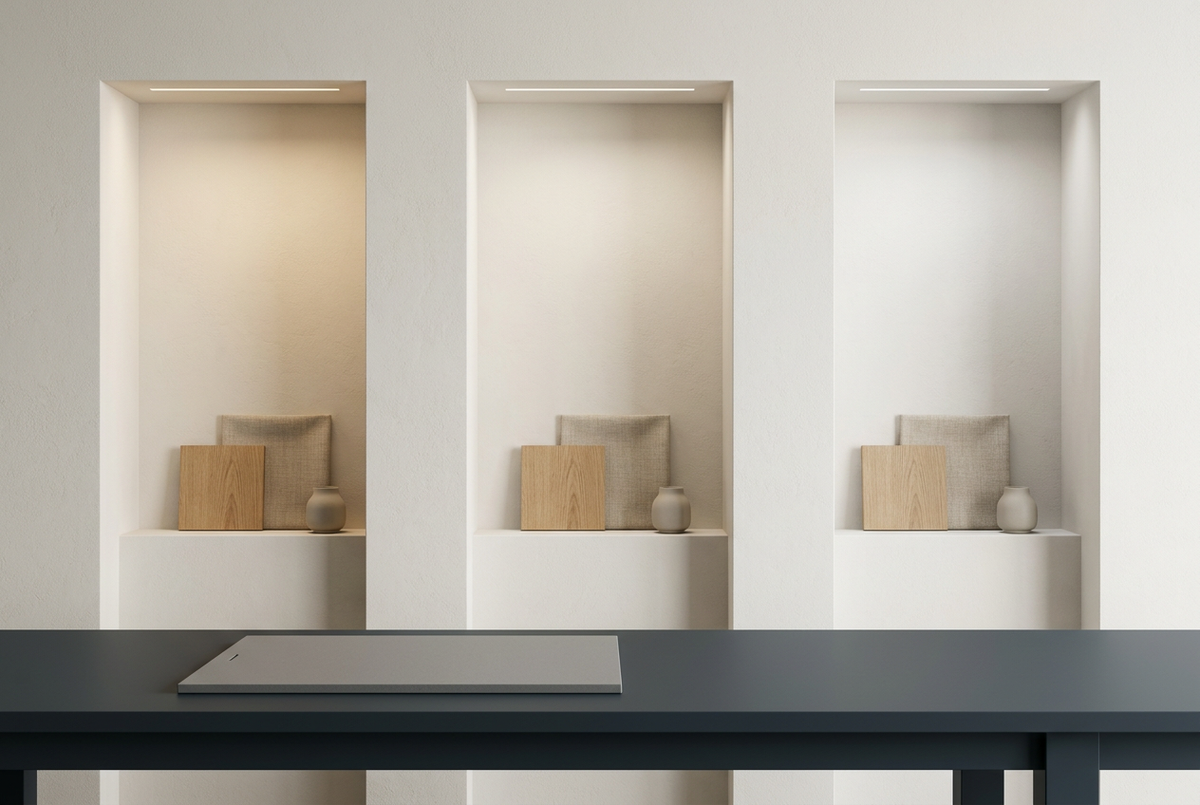
Correlated colour temperature, usually shortened to CCT, is expressed in Kelvin, or K. Lower values appear warmer; higher values appear cooler. In interiors, 2700K, 3000K and 4000K are common points of comparison. Each can work well when it supports the room’s materials, activities and atmosphere.
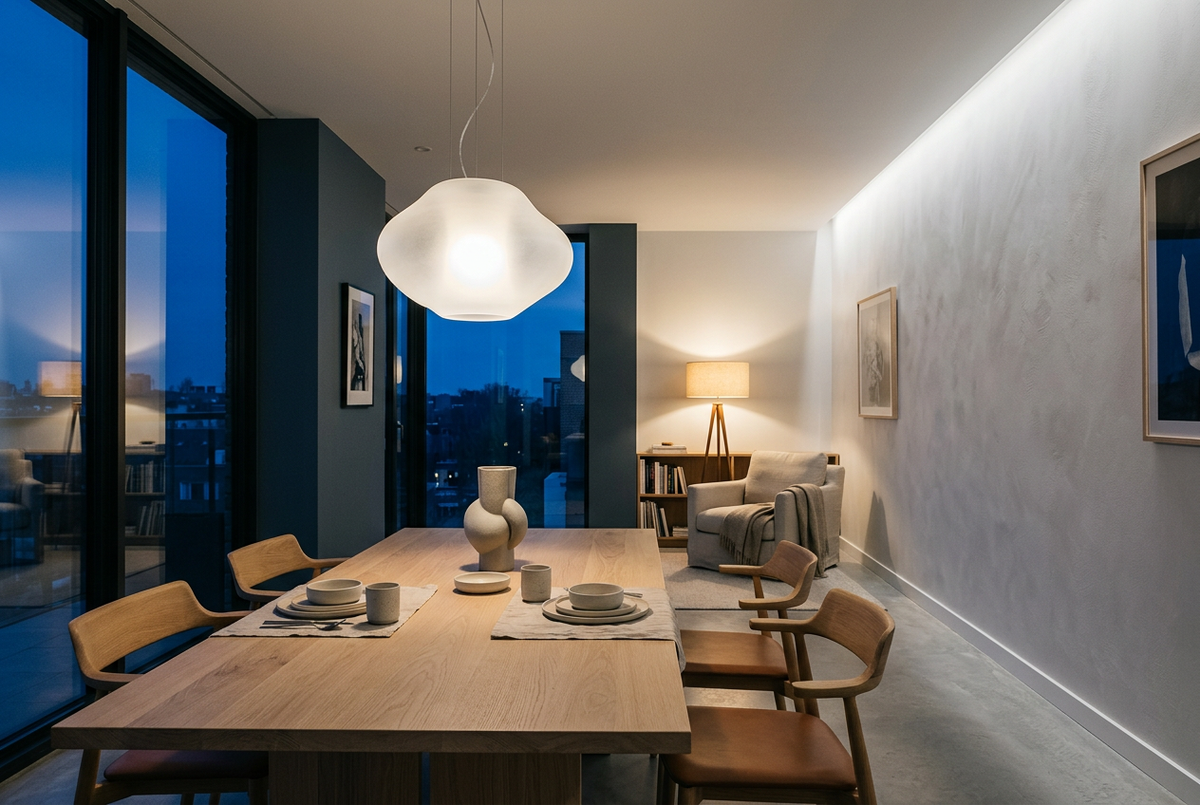
2700K produces a warm appearance often suited to living rooms, bedrooms and intimate dining areas. It can sit comfortably alongside timber, textured upholstery and low evening light. Consider how those surfaces look in daylight as well as under the proposed artificial lighting.
3000K is a useful starting point when a room needs warmth with a slightly crisper appearance. It can suit kitchens, dining areas, circulation spaces and hospitality settings. It is not automatically the right choice for every warm-neutral interior; compare samples in the actual setting.
4000K has a cooler, more neutral appearance that may suit work-focused spaces or particular task areas. It is not inherently brighter than 2700K. A 4000K source can have lower light output than a 2700K source, so compare lumens separately.
Within an open-plan room, begin with a consistent CCT across fittings seen together. Mixing temperatures can be deliberate, but an accidental change between adjacent pendants or downlights often reads as a mismatch. Also check whether a source is fixed-CCT, tunable white or dim-to-warm: these behaviours are not interchangeable.
CRI: how faithfully colours are rendered
The colour rendering index, or CRI, describes how a light source renders colours compared with a reference source. It is different from colour temperature. Two lamps marked 3000K can make the same oak sample or fabric look noticeably different.
For spaces where finishes, skin tones, food or displayed objects matter, CRI 90 or above is a useful starting preference. Treat it as a selection criterion, not a promise that every material will look identical under every source. Standard CRI is an average and does not capture every aspect of colour quality.
For colour-sensitive work, ask for additional colour-rendering information where available, including R9 performance or TM-30 data. More importantly, review a physical sample under the proposed light. A photograph, screen image or headline CRI value cannot fully show how a particular finish will appear in a completed room.
Do not assume that every fitting in a range has the same CRI. Verify the exact light-source option, CCT and model being specified. For replaceable-lamp fittings, the lamp you select determines much of the lighting performance.
Lumens: how much light the source produces
Lumens describe luminous flux, or total visible light output. Watts describe electrical power consumption. Comparing lamps by wattage alone can be misleading because different sources convert electrical power into light with different efficiencies.
Check whether a quoted lumen figure refers to the LED module, a replaceable lamp or the complete luminaire. A shade, diffuser or optical system can reduce and redistribute the light leaving a fitting. Bare-source output and delivered luminaire output are not equivalent measures.
Light on a surface is measured as illuminance, commonly in lux or foot-candles. The amount reaching a tabletop depends on mounting height, beam angle, room geometry, surface reflectance and other light sources. A high-output narrow beam and a lower-output diffuse shade can produce very different results in the same room.
For a project schedule, record the output basis alongside the number. Where calculations are needed, request the relevant photometric information and use the actual room dimensions. There is no reliable universal lumen target that suits every bedroom, kitchen or restaurant.
A room-by-room starting reference
| Space | CCT starting point | Colour-rendering priority | What to check |
|---|---|---|---|
| Living room | 2700K–3000K | Consider CRI 90+ for finishes and skin tones | Layer ambient, reading and accent light; assess seated glare. |
| Bedroom | 2700K–3000K | Check fabrics and finishes under the source | Provide independent bedside control and a comfortable low setting. |
| Dining area | 2700K–3000K | Prioritise food, table finishes and faces | Light the table without exposing diners to uncomfortable glare. |
| Kitchen | 3000K as an initial comparison | Consider CRI 90+ for food and work surfaces | Separate general illumination from task lighting and avoid body shadows. |
| Workspace | Compare 3000K–4000K | Match rendering to the task | Assess screen reflections, contrast, daylight and the work surface. |
| Hospitality interior | Compare 2700K–3000K for guest-facing areas | Review materials, food and displayed objects | Plan separate scenes and evaluate operational tasks independently. |
These ranges are design starting points, not mandatory standards. Select final values against the brief, daylight conditions, user preferences and applicable project requirements. Bathrooms, outdoor areas and other demanding locations also need installation and environmental suitability checks independent of CCT and CRI.
Glare, distribution and dimming belong in the same decision
A fitting can meet the preferred CCT, CRI and lumen figures and still feel uncomfortable. An exposed source at eye level, a bright reflection on a polished table or an overly narrow beam can undermine an otherwise considered scheme.
Review the shade, diffuser and beam distribution from the positions people will actually use. Stand at the kitchen worktop, sit at the dining table and look across the room from the sofa. Check whether the fitting illuminates the intended surface or mainly lights the ceiling and walls.
For dimming, verify compatibility between the specific source, driver and control system. “Dimmable” alone does not describe the dimming method, minimum stable output or behaviour at low settings. Confirm whether the light becomes warmer as it dims or simply reduces output while retaining a similar colour temperature.
A specification checklist to copy into your schedule
Give each fitting a reference code and record its room, purpose, manufacturer, exact model, finish, dimensions and quantity. Add CCT, CRI, lumen output with its measurement basis, beam angle or distribution, and whether the source is integrated or replaceable.
Record power, supply requirements, driver location, control protocol, mounting method and overall suspension length where relevant. Keep installation instructions, applicable product documentation and any required suitability checks with the same reference. Mark unknown information as “to confirm” rather than replacing it with an assumption.
Finally, record who approved the selection and the date of that approval. Review a sample where colour or glare is critical, then confirm the exact product option before ordering. A useful lighting specification is not the longest document; it is the one that makes the intended result clear and keeps every decision traceable.
[Pull quote that captures the key idea.]
[Name], [Role][Caption · credit]
Featured in this article
Recommended levels
- [List item]
- [List item]
- [List item]
| Space | Colour temperature | CRI |
|---|---|---|
| [Space] | [2700K] | [90+] |
| [Space] | [3000K] | [90+] |
| [Space] | [4000K] | [95+] |
Specifier tip
[Short practical note with a link to the relevant product or download.]